.png?width=50&height=50&name=Kevin%20Indig%20headshot%20(2).png)

.png?width=400&height=220&name=Kevin%20Indig%20Blog%20April%202026%20(1).png)
G2 Profile
Why Paid G2 Profiles Earn 2x the AI Citations as Free Ones
The median paid G2 Profile earns 806 AI citations over 180 days. Free listings: 8. That's a...
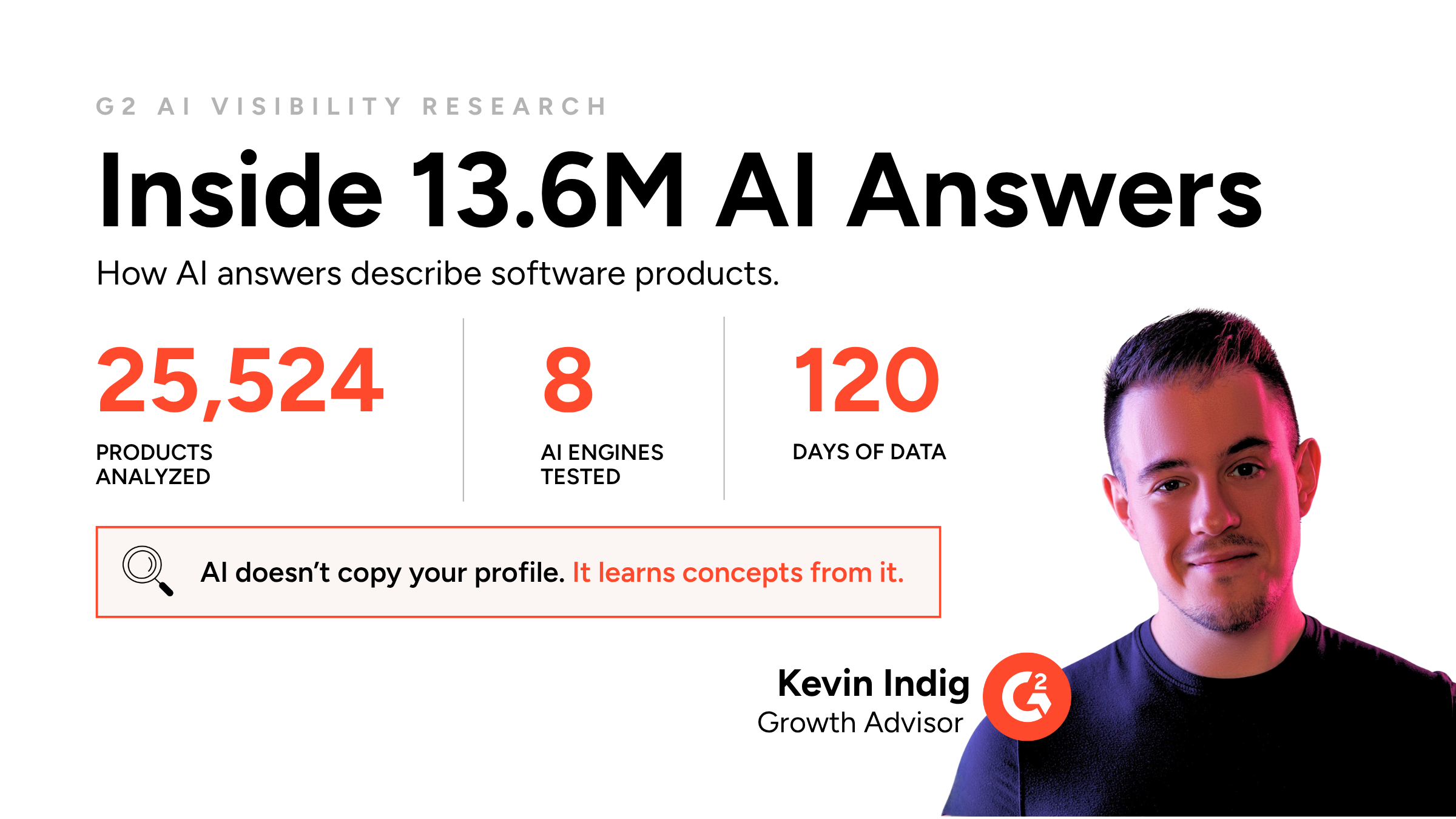
AI learns your product's specifics from your G2 Profile — like integrations, concrete use cases, and unique feature claims — far more than it does from profile length. Across 13.6 million AI answers, those specifics shaped how AI described a product more than generic category language did.
Less than two months ago, we revealed how paid G2 Profiles get cited 2x more often by AI than free ones. The piece traced that gap to reviews and profile completeness, with paid status compounding on top.
It left one key question open: When an AI system describes a product, whose words does it use?
To help answer this question, I ran a test against 13.6 million mention-response pairs across 8 AI answer engines, 120 days, and 25,524 distinct products. For each AI response, I computed cosine similarity between the product's G2 Profile description and the AI answer text using Snowflake Cortex with the e5-base-v2 embedding model.
For those unfamiliar with this methodology, here’s some quick background:
The TL;DR is this: A higher cosine means the answer tracks the profile more closely, so this is what I aimed to uncover.
Yes. A product's own G2 Profile shapes how AI describes it, and the effect is measurable but bounded.
The matched-pair number averages 0.83. On its own, that sounds like AI is repeating 83% of your profile. But there is an important nuance.
The catch with cosine similarity is that the absolute number depends on what you're comparing against. Two unrelated SaaS profiles share register, vocabulary ("platform," "workflow," "enterprise," "automate"), and structure. So I ran a negative control. For each product, I sampled an AI answer about a different product and scored similarity against the original profile. That random-pair average came in at 0.77.
The 6 cosine points of lift over baseline is the real signal. Profile content shapes how AI describes a product, but the effect is bounded, and the mechanism is paraphrase, not copy.
AI does not reproduce your G2 Profile word-for-word; it paraphrases, keeping your concepts and specific claims while rewriting the wording.
We also looked at Jaccard similarity — “a statistical measure used to quantify how similar two sets are.” Here’s what we found: The average Jaccard overlap on 3-grams between profile copy and AI response, across both paid and free profiles, is 0.001. In other words, verbatim repetition of profiles does not happen. The same product's profile and its AI description share concepts, ordering, and sometimes specific feature names.
Take ClickCease, a click-fraud protection tool. Its G2 Profile reads: "ClickCease uses advanced algorithms and real-time monitoring to detect and block malicious sources before they waste your budget...Each visit goes through over 2,000 behavioral tests."
ChatGPT, when asked to compare ClickCease against a competitor, wrote: "Designed specifically to detect and block invalid clicks on Google, Meta, and Microsoft Ads in real time...uses advanced algorithms and real-time behavioral detection." Different sentences. Same specific claims (real-time, detect and block, behavioral, the named ad networks).
The mechanism matters because it changes what vendors should optimize. Models pay attention to which concepts repeat across the profile, not which exact words.
Paid G2 Profiles show higher messaging fidelity than free ones, and the gap holds across every review count and profile length.
First, I’d like to acknowledge that G2 Profile fields are identical for free and paid vendors. This gap we’ve uncovered in how profiles affect AI answers reflects how vendors use them, not what they have access to.
With this in mind, let’s dig in further. The customer-matched-pair average is 0.838, compared to 0.822 for non-customer-matched pairs. That's a 1.6 cosine-point gap, and the gap holds up against the obvious challenges.
The first challenge is review volume. Paying customers on G2 have 11x more reviews than free vendors in the sample (297 versus 27 on average). Reviews drive citations, as my April piece established, and they might also be driving fidelity. Binning by review count rules this out:
|
Reviews |
Customer matched |
Free matched |
Gap |
|
Under 10 |
0.841 |
0.820 |
+0.021 |
|
10 to 49 |
0.841 |
0.823 |
+0.018 |
|
50 to 199 |
0.837 |
0.823 |
+0.014 |
|
200+ |
0.831 |
0.820 |
+0.011 |
The gap appears at every review level. It also narrows as reviews accumulate, which means the profile lift matters most when reviews are scarce. Once a product has hundreds of reviews, the model pulls more of its description from review content, and the profile's relative footprint shrinks.
Here is the more interesting test. If paid customers track better simply because they write longer descriptions, the lift should scale with profile length identically across both segments. It doesn't.
|
Profile length (chars) |
Customer lift over baseline |
Free lift over baseline |
|
120 to 249 |
+0.054 |
+0.050 |
|
250 to 599 |
+0.062 |
+0.054 |
|
600 to 1199 |
+0.065 |
+0.054 |
|
1200 to 2499 |
+0.069 |
+0.054 |
|
2500+ |
+0.072 |
+0.057 |
Read the table two ways:
There are two key findings stacked on the same table. If more text alone gave the model more to paraphrase, both lines would climb together. They don't, which says what fills the length matters more than the length itself. Paying customers tend to spend more characters on product-distinct language: specific feature claims, named integrations, and concrete use cases. Free profiles at 2,500 characters tend to stretch the same category-generic phrasing the model already knew from the genre baseline.
Specificity is the dominant lever, and length is the proxy that reveals it. Paid status compounds on top, as the persistent gap between the lines at every length shows that paying has a marginal effect that content effort alone doesn't replicate.
The pattern holds across all eight models tested, but the size of the customer edge varies.
|
AI Engine |
Customer matched |
Free matched |
Customer edge |
|
Perplexity |
0.848 |
0.830 |
+0.019 |
|
Google Gemini |
0.839 |
0.818 |
+0.021 |
|
Microsoft Copilot |
0.840 |
0.823 |
+0.017 |
|
Google AI Mode |
0.839 |
0.823 |
+0.017 |
|
Google AI Overviews |
0.839 |
0.822 |
+0.017 |
|
Grok |
0.834 |
0.818 |
+0.016 |
|
ChatGPT |
0.835 |
0.823 |
+0.012 |
|
Meta AI |
0.835 |
0.832 |
+0.003 |
Perplexity tracks profile copy the tightest, which fits its retrieval-grounded design. The model fetches sources at query time and stays close to what those sources say. Google Gemini shows the widest gap between paid and free profiles.
ChatGPT ranks at the bottom among major models. The common assumption is that ChatGPT prefers official sources, including vendor pages, more than peers. The data here doesn't support that, at least not for G2 Profiles specifically. Whatever ChatGPT is weighing the most, it isn't profile fidelity.
Meta AI is the outlier in both directions. Smallest sample (6,855 customer pairs vs 16,000+ for the others) and smallest edge. The result is suggestive, not conclusive.
The paywall does not unlock additional content fields. G2's own marketing profiles documentation confirms it: overview, features, screenshots, videos, integrations, pricing. Paying unlocks sales infrastructure on top, namely CTAs, badge licensing, competitor ad suppression, lead routing, and analytics. Those drive the citation-volume side measured in the April piece. They don't move messaging fidelity directly.
The customer edge in this data correlates with operational discipline. Paying vendors fill the fields. They update them. They write product-specific language because their GTM motion depends on it. Free vendors with the same access to the same fields tend not to do the work, and when they do, they stretch generic language rather than use specific language.
Effort isn't the whole story, though. A free vendor writing at maximum length (2,500+ characters) still only reaches +0.057 lift over baseline. A paying customer at the same length reaches +0.072. That gap matches the aggregate paid-vs-free gap almost exactly, which means even maxed-out free profiles don't catch maxed-out paid ones. Paying retains a measurable edge of its own.
My April piece found the same shape for citation volume: reviews dominate, completeness adds a second-order lift, and paid status compounds on top. This piece finds the same shape for messaging fidelity.
Two levers. The bigger one is content specificity: named integrations, concrete use cases, feature claims your competitors can't copy. Every vendor can pull this lever, and the 6 cosine points of lift above baseline mostly live there. The smaller lever is paying. It compounds on top, and the compounding effect is real and measurable. Pull the first lever first. Then pull the second.
Yes. Across 13.6 million AI answer-product pairs, AI-generated descriptions were significantly more similar to a product's own G2 Profile than to unrelated product profiles. The study found a 6-point cosine similarity lift above baseline, indicating that G2 Profile content influences how AI systems describe products.
No. The study found an average 3-gram Jaccard similarity score of 0.001, indicating that AI systems rarely reproduce profile text verbatim. Instead, they preserve concepts, feature claims, integrations, and positioning while rewriting the language.
Product-specific information has the greatest impact on AI-generated descriptions. Named integrations, unique feature claims, and concrete use cases influence AI answers more than generic category language. Profile length matters only when the additional content adds specificity.
Reviews are the largest driver of AI citations and product discovery, while profile descriptions shape how AI explains and positions a product. Paid profiles consistently show higher messaging fidelity than free profiles, suggesting that profile completeness and specificity influence AI-generated descriptions.
Among the models studied, Perplexity showed the strongest profile fidelity, followed by Gemini, Copilot, Google AI Mode, and Google AI Overviews. ChatGPT demonstrated a smaller profile-fidelity advantage, while Meta AI showed the weakest measurable difference in the dataset.
Specificity matters more than length. Vendors that clearly describe unique features, integrations, and use cases are more likely to have those differentiators reflected in AI-generated answers, summaries, and comparisons.
.png?width=800&height=150&name=Kevin%20Indig%20headshot%20(2).png)
Kevin Indig is an advisor to some of the world’s fastest-growing startups and has defined Organic Growth strategies for companies like Ramp, Reddit, Bounce, Dropbox, Hims, Nextdoor, and Snapchat. Kevin led SEO and Growth at the world’s leading e-commerce platform Shopify, the #1 marketplace for software G2 and the #1 developer company Atlassian. Once a week, he sends The Growth Memo to 20k+ subscribers and regularly speaks at conferences around the world.
The median paid G2 Profile earns 806 AI citations over 180 days. Free listings: 8. That's a...
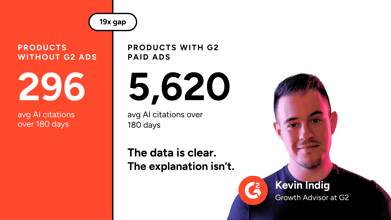
We recently made an interesting discovery. Paid Ads on G2 seem to correlate with higher AI...
.png?width=400&height=220&name=Kevin%20Indig%20Blogs%20AprilMay%202026%20(1).png)
When it comes to software buying decisions, AI has already overtaken humans as consumers of...