When it comes to software buying decisions, AI has already overtaken humans as consumers of the web.
Using Profound, I analyzed citations by ChatGPT, Perplexity, and Google’s AI surfaces and pageviews over 180 days across 80,000+ G2 products. Profound tracks both AI citations (how often a product gets mentioned in AI-generated responses) and traditional pageviews on g2.com.
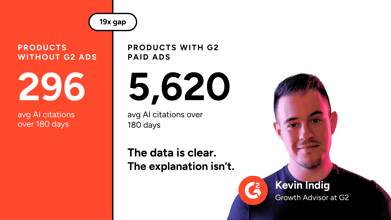
What did I find? The median G2 product is now cited by AI models more often than it is clicked by a human buyer. This is despite the fact that G2 reaches millions of human buyers every month! For paid profiles, the ratio is 4x compared to 2x for free listings.
- The aggregate citation-to-pageview ratio across all products is 4.9x. For every human who visits a G2 profile, AI models cite that product nearly five times.
- 80% of all products have more AI citations than pageviews. This holds across both tiers and most categories.
The split by tier tells a more specific story. 94.6% of paid profiles have more citations than pageviews, with a median ratio of 4.05x. For free listings, 78.8% cross the threshold, with a median of 2.0x.
1) Paid profiles win on every cut that matters
A handful of free listings post extreme citation-to-pageview ratios:
These are developer-heavy products with strong brand recognition and documentation. Despite lower pageview traffic on G2 compared to other categories, they are frequently cited by AI models because the category is technical, and the G2 page is the structured reference that large language models (LLMs) reach for.
Those outliers pull the free-tier average up to 5.17x, slightly above paid at 4.75x. It's the only case where free appears to edge paid, and it's an artifact of four products.
Every other cut favors paid.
- Median paid ratio: 4.05x
- Median free: 2.00x
Twice the multiple at the typical listing. 94.6% of paid profiles get more AI citations than pageviews; 78.8% of free listings do. 11.6% of paid products clear a 10x ratio versus 3% of free.
Paid profiles don't just get more citations in absolute terms. They convert visibility into a higher multiple more reliably, across more of the listing base.
2) Brand recognition plus structured data drives the ratio
If 80% of G2 products are cited more than viewed, the question is why some products hit 50x or 90x while most sit near the median. The top of the distribution is where the mechanism becomes visible.
The top 50 products by citation-to-pageview ratio cut across categories. Developer tools and APIs sit at the top: Weaviate (74x), AssemblyAI (67x), Google Cloud Speech-to-Text (67x), Mapbox (63x), and Tailscale (56x). Consumer and horizontal SaaS sit slightly lower but in the same range: Manychat and Make (42x each), Buffer and Acuity Scheduling (30x each), and Fireflies.ai (25x). The ratio is a cross-category phenomenon with a modest dev-tools premium, not two different stories.
What these products share is that LLMs already know about them, and G2 is where models go to cite them. G2 pages have what LLMs prefer to reference: star ratings, feature comparisons, category context, and user sentiment in a structured format. That combination of brand recognition and structured review data is what drives the ratio, regardless of vertical.
3) What a G2 profile actually is now
For 80% of tracked products, the primary consumer of a G2 Profile is an AI model, not a human buyer. That changes what “profile optimization” means.
Human buyers scan headlines, skim screenshots, and compare (three) products side by side. LLMs parse structured fields: rating scores, feature lists, category placements, review text, and comparison data. The two audiences read the same page differently.
Profile completeness has always mattered for conversion. Now it matters for citation volume. Empty fields reduce what LLMs can extract and reference. Missing feature comparisons are missed citation opportunities in responses where models compare alternatives.
Human visitors still matter. A buyer who clicks through to your G2 page is high-intent. But for every one of those buyers, four or five AI-generated responses mention your product to someone who never visits G2. The influenced audience is larger than the visiting audience.
4) How to increase AI citations from your G2 profile
The shift from pageview-first to citation-first changes priorities for G2 Profile owners:
- Fill every structured field: Features, integrations, FAQs, comparison data. These are the fields LLMs pull from when generating recommendations. Profiles with 75%+ completeness earn significantly more citations than bare profiles in both tiers.
- Treat reviews as training data: Review text gives LLMs the language to describe your product. Citable reviews are use-case specific. A review that says "we use it for onboarding new hires in 3 days instead of 2 weeks" is better than "great product, love it." To drive the right reviews, ask for them at the moment of value (after a customer hits a milestone in your product, not on day 30 of a renewal cycle) and prompt for the job-to-be-done, the measurable outcome, and the alternative they replaced. Audit your existing reviews for category coverage. If LLMs cite you for CRM but not for pipeline forecasting, you need reviews that mention forecasting by name.
- Update your category inclusion: LLMs use G2 categories as the taxonomy for software recommendations. If your product sits in the wrong category or misses a relevant one, you're invisible in an entire class of AI-generated responses. To find the right categories, start with the prompts your buyers actually use. Run them for your use cases ("best tools for X", "alternatives to Y") and note which G2 categories the cited products share. Claim every category where a direct competitor is listed. Add adjacent categories for workflows your product supports but doesn't lead with. Most products sit in 2-3 G2 categories when they could credibly sit in 5-7.
AI-generated answers keep replacing search clicks. G2's structured review format is what these models are built to cite, and the vendors who treat their profiles as AI-readable data sources win the next cycle of citation share.
content_marketing_seller
.png?width=50&height=50&name=Kevin%20Indig%20headshot%20(2).png)
.png?width=400&height=220&name=Kevin%20Indig%20Blog%20April%202026%20(1).png)
.png)

.png?width=800&height=150&name=Kevin%20Indig%20headshot%20(2).png)