Every software vendor investing in reviews wants to know the same answer: How long until those reviews show up and impact my visibility in ChatGPT and other AI systems?
As a growth advisor, I work with G2 on this exact question, with direct access to the company’s live feed of published reviews joined to user-prompted AI citations from ChatGPT, Perplexity, Apple, and Google, day by day, from July 2025 on.
To uncover the answer, I analyzed 2,514 products listed on G2 that received a burst of reviews (5+ published, non-stub reviews in a 14-day window), which were then tracked against their AI citations for the 12 weeks after.
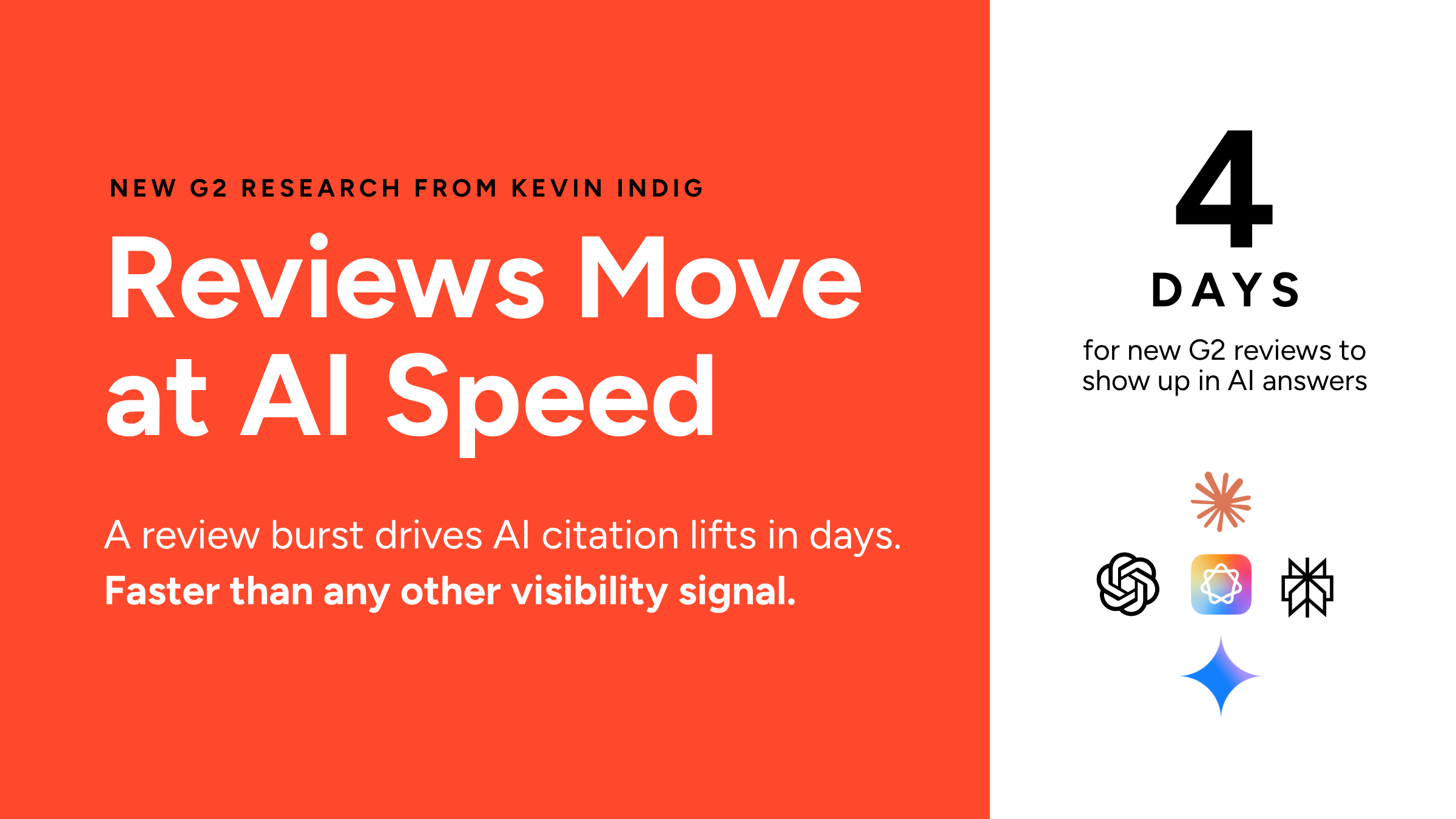
And here’s what I found: When a wave of new reviews moves a product's AI citations, the first lift shows up in a median of four days.
AI search platforms pick up reviews faster than almost any other content signal. The speed is the headline. The nuance, which products gain most and how durable the lift is, is where the real playbook lives.
TL;DR
- Reviews can influence AI visibility much faster than most vendors expect. Across 2,514 G2 products whose citations responded, the median time from a review burst to the first AI citation lift was four days.
- Citation gains happen in two stages: an initial lift within days and a sustained lift that typically settles in around three weeks.
- Products with low existing AI visibility see the biggest gains. Under-cited products experienced an 11.6-point increase in citation-bump probability after a review burst.
- Products already heavily cited by AI gain little from short-term review velocity because they have less citation headroom.
- Review velocity creates movement, but review volume determines the ceiling. The biggest long-term AI visibility gains come from consistently accumulating reviews over time.
Bottom line: When reviews move AI citations, they move quickly. The biggest gains go to products that AI rarely mentions today, while heavily cited products benefit more from continuing to build review volume.
When it lands, it lands fast
Take the products whose citations rose after a review burst and measure the gap from the burst to the first day citations clear their baseline. The median is four days. A quarter move within a single day. 90% move within a month.
|
Share of responding products
|
Days to first citation lift
|
|
25%
|
within 1 day
|
|
50% (median)
|
within 4 days
|
|
75%
|
within 12 days
|
|
90%
|
within 31 days
|
Half of the products that respond do so inside a single week.
The speed comes from how AI sources G2. The models lean on G2's structured review data, and G2 pages get re-crawled and re-indexed quickly, so a published review reaches the models within days. Compared to building backlinks or waiting on a domain to age, this is one of the fastest visibility signals available. A review you collect this week can shape an AI answer next week.
The first flicker, then the real lift
Four days is the first flicker, not the finished story. That median marks the first day a product's citations rise above its pre-burst baseline. The durable, sustained lift settles in over about three weeks as the models see the new reviews consistently.
|
Stage
|
What it measures
|
Median time
|
|
First flicker
|
First day citations clear baseline
|
4 days
|
|
Sustained lift
|
First week that holds above baseline
|
3 weeks
|
So the timing comes in two stages: a fast first response within days, then a stable higher-level over the following few weeks. Both stages are quick by SEO standards, where content changes can take months to register. For a vendor running a review push before a launch or a renewal cycle, the AI payoff arrives inside the same quarter.
Where the lift is biggest
The size of the gain depends on where a product starts. Matched against comparable products that got no burst, a review wave lifts the odds of a citation bump by 6.9 points on average, from 43% to 50%. Split that by how often the product was cited, and one group stands out.
|
Starting citation level
|
Burst bump rate
|
Matched control
|
Lift
|
|
Under-cited (under 20/day)
|
52%
|
41%
|
+11.6 pts
|
|
Well-cited (20+/day)
|
41%
|
50%
|
-8.7 pts
|
For products AI barely cites yet, a review burst lifts bump odds by 11.6 points, a meaningful jump from a standing start. This is the clearest win in the data: If the models don't mention you much today, a wave of reviews is one of the fastest ways onto the page.
The honest limit sits in the second row. For products AI already cites heavily, a fresh burst does little; the number even drifts slightly negative within the measurement window. Once a product is saturated in citations, more reviews in a two-week sprint don't move the short-term needle. The reviews still reach the models in days; there's simply less room left to gain.
Headroom is the variable. A product the models rarely mention has somewhere to go. A product already everywhere in AI answers has less to gain from any single burst. That's not a knock on reviews. It's the same pattern any visibility channel shows once you're already winning.
Volume builds the ceiling that velocity climbs
The burst is the accelerator, but the accumulated review volume is the engine. Review count drives citation level harder than any other on-profile signal: On G2, going from zero to 500+ reviews lifts a free product's median AI citations more than 800x.
That relationship is why the velocity finding reads the way it does. Volume sets how high a product can be cited; a burst helps it climb toward that ceiling fastest when it's still well below it. The two work together. Steady review collection raises the ceiling over time, and a focused burst speeds the climb, especially for products that haven't been cited much yet.
For an already-saturated product, the lever isn't a two-week sprint. It's continuing to compound reviews, so the ceiling keeps rising, while the velocity payoff shifts to the newer products in the portfolio that still have room.
Reviews reach AI in days, and the room to gain decides the size
The timing answer is fast. When reviews move AI citations, the first response lands in about four days, and the durable lift comes within a few weeks, quicker than almost any other visibility signal a vendor can pull.
The size of that lift tracks headroom. Under-cited products gain the most from a burst of reviews, double-digit points of citation probability. Well-cited products gain little from velocity alone and rely on accumulated volume to push their ceiling higher. Either way, reviews are the input AI reads first and fastest. The question for an operator isn't whether to invest in reviews. It's which products in the portfolio have the most room for that investment to show up in AI answer engines.
Frequently asked questions
How long does it take reviews to influence AI citations?
Across 2,514 G2 products, the median time from a review burst to the first AI citation lift was four days. Twenty-five percent of responding products saw movement within one day, 50% within four days, 75% within 12 days, and 90% within 31 days.
How long does it take for a review-driven citation lift to become durable?
The first citation lift is only the beginning. While the median time to first lift was four days, the median time to a sustained citation lift was approximately three weeks. In other words, AI systems often react within days, but lasting gains typically take several weeks to stabilize.
Which products benefit most from a review burst?
Products with the most citation headroom benefit the most. Products receiving fewer than 20 AI citations per day experienced a 52% citation-bump rate after a review burst, compared with 41% for matched control products that did not experience a burst. That's a lift of 11.6 percentage points.
Do review bursts help products that are already heavily cited by AI?
Not as much. Products already receiving 20 or more AI citations per day showed little short-term benefit from review velocity alone, suggesting that citation headroom is the primary constraint.
Is review velocity more important than total review volume?
No. Review velocity and review volume serve different purposes. Review velocity can accelerate visibility gains, while total review volume appears to have a stronger relationship with long-term citation levels. The highest-performing products typically benefit from both.
Methodology: 2,514 G2 products with a review burst (5+ published, non-stub reviews in a 14-day window) from July 2025 onward, tracked against user-triggered AI citations (ChatGPT, Perplexity, Apple, Google) from G2's day-level citation feed. A "bump" is a post-burst week at 1.5x the pre-burst baseline plus at least 10 absolute citations. Time-to-first-lift measured as days from burst to the first day citations clear 1.5x baseline. Control products (reviews and citations, no burst) ran through the identical test, matched on review-count band and baseline-citation band. The matched effect is directional, not causal: a seeded experiment would confirm it. The control comparison holds only below 25 reviews, where most vendors sit.
content_marketing_seller
.png?width=50&height=50&name=Kevin%20Indig%20headshot%20(2).png)

.png?width=800&height=150&name=Kevin%20Indig%20headshot%20(2).png)
.png?width=400&height=220&name=Kevin%20Indig%20Blog%20April%202026%20(1).png)
.png?width=400&height=220&name=Kevin%20Indig%20Blogs%20AprilMay%202026%20(1).png)