
G2 MCP: Real Buyer Signals, Right Inside Your AI Tools
Paying for buyer data and actually using it are two different things. Most teams are still...

Yes, our web traffic has grown by 20%. Yes, G2 is being increasingly cited by AI LLMs for B2B software research. Yes, software buyers are discovering brands through G2 reviews and data citations.
But what happens next when those buyers land on G2?
They’re evaluating software by asking blunt, practical questions inside an AI-powered experience, expecting clear answers long before they ever speak to a vendor’s sales team. Showing up in these moments can make or break the deal for software sellers.
To find out what those questions really look like, we analyzed 73,593 real buyer prompts submitted to G2’s AI chatbot between December 2025 and early January 2026. What emerged wasn’t vague “intent,” but a sharp, repeatable set of questions buyers rely on to evaluate, validate, and move forward with software decisions.
The takeaway is simple but urgent: if your G2 reviews don’t answer these questions, buyers will look elsewhere for answers.
Dataset used
73,593 anonymized, first-party buyer prompts submitted to G2’s AI chatbot
Timeframe analyzed
December 2025 through early January 2026
What we analyzed
Natural-language buyer questions, cleaned and normalized to identify recurring FAQ themes, repetition patterns, and funnel-stage signals
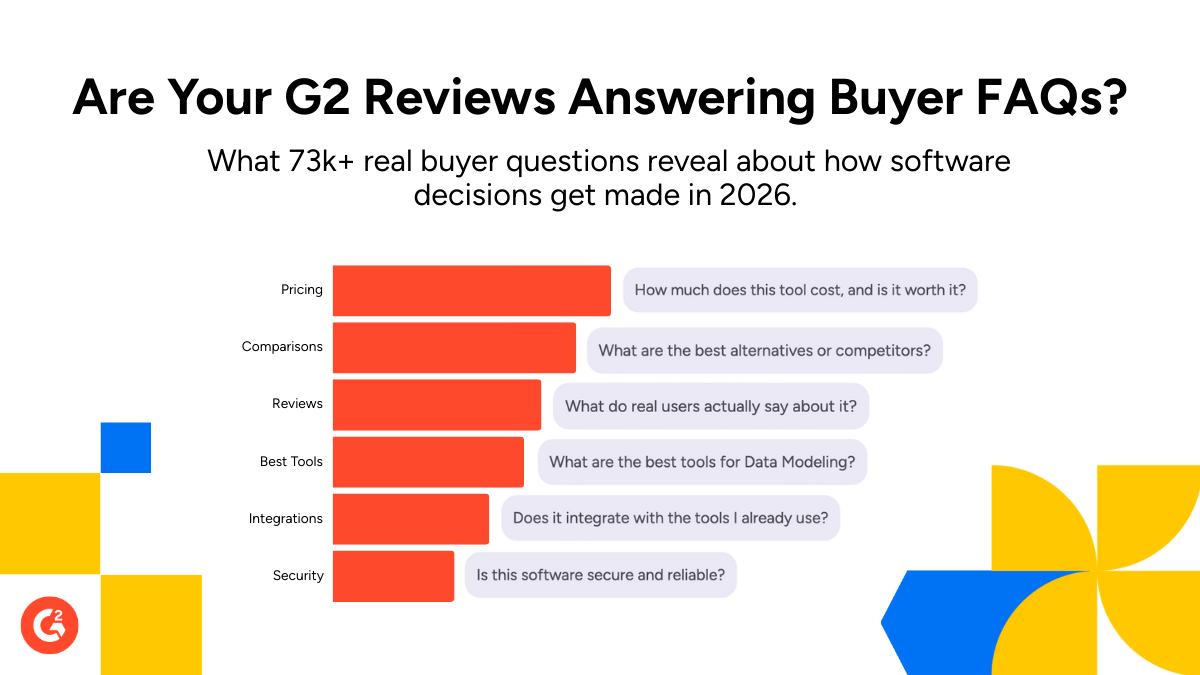
Looking specifically at January 2026 thus far, buyer behavior has sharpened rather than expanded. The most common questions clustered around a tight set of decision-oriented themes:
These aren’t exploratory questions. They’re evaluation and validation questions, asked when buyers are deciding whether to move forward — or move on.
The questions themselves didn’t radically change, but how buyers asked them did.
Three notable shifts stood out:
The same trend applies to security requirements, as the rise in AI-powered tech stacks has increased InfoSec involvement in purchasing decisions.
What this tells sellers: January didn’t create new prerequisites for buyers. It amplified existing ones and made them more decisive.
Note: The FAQs and keywords are anonymized to maintain neutrality of information.
Across all 73,593 prompts, buyer questions consistently clustered into a handful of core themes. These are not edge cases. They’re the questions buyers return to repeatedly during evaluation.
Here’s a breakdown of the types of questions by parameter:
The G2 signal: Buyers want pricing with context, not just numbers.
The G2 signal: Buyers are self-directing shortlists — and reviews often influence the outcome. They want product comparisons side by side and at a glance to inform their shortlists.
Pro Tip: Use G2 Compare Reports to close the “vs” gap faster.
Compare products on features, ratings, and real user feedback.
The G2 signal: Integration clarity is a deal-maker — or a deal-breaker.
The G2 signal: Buyers want relevance and personalization, not generic positioning.
The G2 signal: Questions that build confidence and trust appear before buyers commit to a shortlist.
The G2 signal: Buyers assume friction unless proven otherwise.
The G2 signal: Security concerns are now mainstream, not niche.
The G2 signal: Buyers actively look for risk-mitigation language.
A small number of question patterns account for a large share of buyer prompts.
|
Repeated pattern category |
Representative buyer language |
Share of total prompts |
|
Pricing-related |
“pricing,” “cost,” “price” |
~16% |
|
Alternatives and comparisons |
“alternatives,” “vs,” “compare” |
~14% |
|
Reviews and proof |
“reviews,” “real users” |
~12% |
|
Best tools discovery |
“best,” “top tools” |
~11% |
|
Integrations |
“integrate with,” “connect to” |
~9% |
|
Security and trust |
“safe,” “secure,” “compliant” |
~7% |
Key insight: Buyer signals are concentrated, not scattered. Buyers repeatedly ask a small set of core questions.
When reviews answer these questions clearly, they amplify influence, reduce evaluation friction, and increase buyer confidence at the exact moment decisions are made.
Some buyer behavior doesn’t show up as clean questions, but it’s still telling. Among the most common searches:
These searches reflect urgency, not curiosity.
When mapped to funnel signals, most prompts cluster around evaluation and validation, not awareness.
Reviews are no longer just social proof. They are the infrastructure to inform decisions throughout every stage of the buying journey. Software vendors need stronger review generation strategies to answer these queries with clarity and transparency. And when a real customer answers these questions versus a vendor-supplied marketing asset, the answers are much more trustworthy.
This is where buyer behavior turns into seller advantage.
The same buyer questions create different pressure points across teams. These persona-mapped insights clarify how teams can approach strategy and work together to create sales momentum.
For marketing and sales leadership
Buyers are asking questions that, when left unanswered, directly block shortlisting. When reviews fail to address pricing clarity, comparisons, and trust, deals stall — often without a visible objection.
For brand builders (marketing leadership, SEO, content, comms)
Buyer language is blunt and informal, far from polished brand copy. Reviews increasingly function as AI-readable brand proof, not just testimonials. Using these as part of your brand marketing strategy can be the differentiating factor.
For demand generation teams
FAQ-shaped buyer questions surface ready-made content angles that help accelerate evaluation, not just drive awareness.
For RevOps and MOPs
Repeated operational and access-related questions signal friction that affects conversion, not top-of-funnel engagement.
For customer and product marketing
Buyers seek clarity on fit, setup, and outcomes more than feature depth — especially as they move closer to a decision.
Knowing what buyers ask is only half the equation. What matters next is how sellers respond.
If you want your reviews to reduce friction and reinforce confidence at the point of evaluation, use this framework to translate real buyer questions into concrete review signals your team can act on immediately.
Pro Tip: Not only do reviews help answer buyer questions directly on G2, but they also feed LLMs and AI Overviews — meaning they can be discovered wherever your buyers are searching.
Explore Answer Engine Optimization (AEO) solutions and G2’s AI Visibility Dashboard to measure your brand's AI search visibility.
|
Buyer question |
Your G2 reviews should clearly show |
|
Is it worth the price? |
ROI, outcomes, value context |
|
How does it compare? |
Real comparisons and differentiation |
|
Is it secure? |
Compliance and trust language |
|
Is it easy to use? |
Onboarding speed and usability proof |
|
Can it integrate with my stack? |
Named tools and workflows |
 Do reviews mention pricing in context, not just cost? Do users reference competitors or alternatives? Are integrations named explicitly? Is onboarding described in plain language? Do reviews address security and reliability?
AI hasn’t changed what buyers care about, but it has changed how, when, and where they ask.
The software companies that win next won’t just collect more reviews. They’ll make sure their reviews answer the questions buyers are already asking — clearly, credibly, and at exactly the right moment.
Because in an AI-driven buying journey, the right answer at the right time makes all the difference.
If you want to understand what buyers are signaling across your category and how to turn that insight into action, explore G2’s buyer signals.
Want to measure your brand’s AI visibility? Explore Answer Engine Optimization (AEO) solutions and G2’s AI Visibility Dashboard.
Edited by Supanna Das

Paying for buyer data and actually using it are two different things. Most teams are still...

A B2B sales strategy is always about the customer's emotions.

Software buyers are researching, comparing, and making decisions based on the social proof and...