












Frequently asked questions on G2 Buyer Intent
G2 Buyer Intent is based on verified buyer evaluation, not modeled or inferred behavior. Unlike topic-based or engagement intent that signals early research, G2 captures purchase-proximate actions taken by buyers actively comparing vendors, making it more closely aligned to pipeline and revenue outcomes.
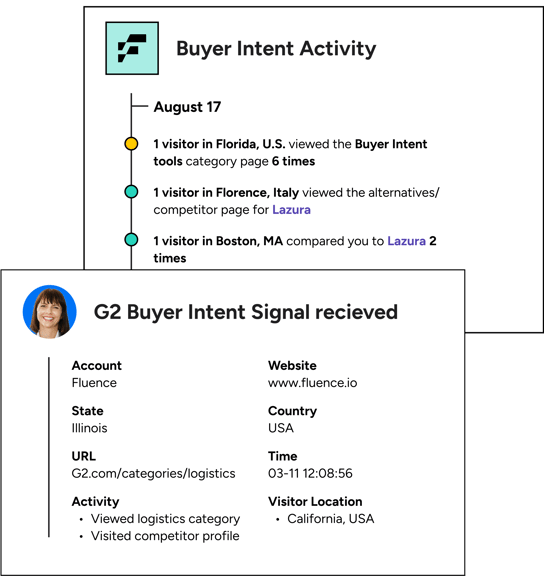
G2 Buyer Intent signals are generated from high-intent actions, including:
- Product and category page views
- Competitor comparisons
- Pricing page engagement
- Review consumption and contribution
- These actions reflect real evaluation behavior during the buying process.
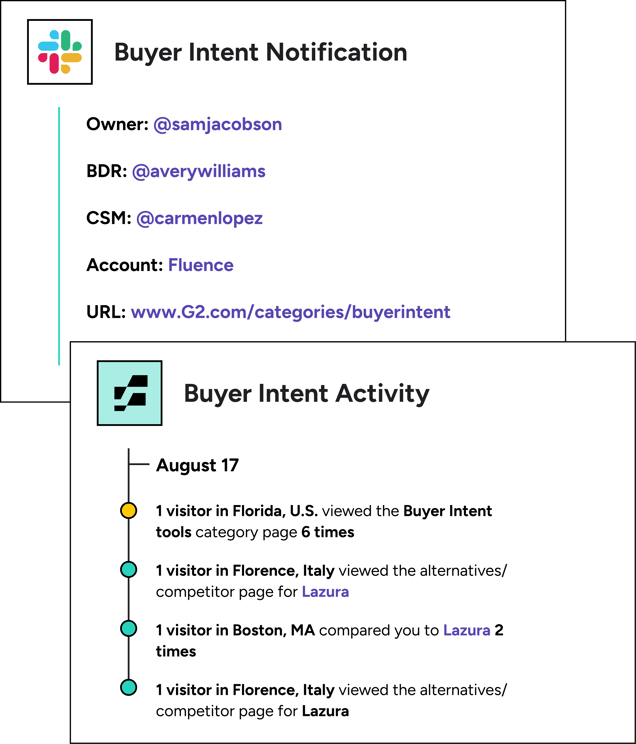
Yes. G2 Buyer Intent integrates directly with Salesforce. Intent signals can be routed into Salesforce to support lead scoring, account prioritization, routing, and sales workflows. This helps teams act on buyer activity in real time.
Yes. G2 Buyer Intent integrates with leading GTM and ABM platforms including 6sense, Demandbase, HubSpot, Outreach, and others. These integrations allow teams to activate buyer intent across advertising, outbound, scoring, and orchestration workflows.
G2 Buyer Intent is designed for:
- Sales teams prioritizing in-market accounts
- Marketing teams activating demand and ABM campaigns
- RevOps teams improving routing and scoring accuracy
- Revenue leaders focused on pipeline efficiency and ROI
It is especially valuable for teams selling B2B software with longer buying cycles and multiple stakeholders.
G2 Buyer Intent is most valuable in the mid-to-late stages of the buying journey. It helps teams identify accounts that have moved beyond awareness and are actively evaluating vendors. This supports prioritization, competitive plays, and late-stage acceleration.
No. G2 Buyer Intent is designed to complement existing GTM platforms, not replace them. G2 provides the buyer truth layer that powers execution in tools like CRMs, ABM platforms, and sales engagement systems.